


A child who is autistic, has ADHD, experiences anxiety, or has a combination of these conditions may have very different needs from another child with the same diagnoses.
One child may become overwhelmed by unpredictable transitions. Another may understand the routine but have difficulty sustaining attention long enough to complete it. A third may avoid the task because of fear of making a mistake. A child with all three conditions may experience several of these processes at once.
This is why support cannot be reduced to one therapy, one behavior plan, or one set of accommodations.
Autism, attention-deficit/hyperactivity disorder (ADHD), and anxiety frequently overlap in childhood. A large systematic review and meta-analysis of co-occurring conditions in autism found ADHD and anxiety among the most common accompanying diagnoses. Population-based estimates are generally lower than rates reported in specialty clinics, but the overlap remains substantial.
A 2024 meta-analysis focused specifically on anxiety in autistic children and adolescents found clinically elevated anxiety symptoms in approximately one third of community samples, while approximately one in five met criteria for an anxiety disorder on diagnostic interviews. The authors also found wide variation between studies depending on how anxiety was measured.
ADHD frequently occurs alongside autism as well. A 2024 population study found ADHD in approximately 33% of autistic children who underwent diagnostic assessment, while a 2023 systematic review found highly variable estimates depending on the population, measures, and diagnostic criteria used.
The practical consequence is straightforward: when a child is struggling, clinicians and caregivers need to determine which process is contributing to the difficulty rather than assuming every behavior belongs to autism, ADHD, or anxiety.
Autism, ADHD, and Anxiety Can Produce Similar Behaviors for Different Reasons
Consider a child who refuses to enter a noisy birthday party.
The refusal could reflect sensory discomfort associated with autism. It could reflect social anxiety. It could reflect difficulty regulating attention and arousal in a highly stimulating environment. It could reflect uncertainty because the child does not know what will happen after entering.
More than one explanation may be correct.
The same problem occurs in classrooms.
A student who does not begin an assignment after the teacher gives oral directions may have missed part of the instruction because attention shifted. The student may not have understood the language. They may understand the task but be anxious about completing it incorrectly. They may have difficulty organizing the first step. Or they may be overwhelmed by the noise and activity surrounding them.
Current ADHD guidance explicitly recommends screening children for co-occurring emotional, developmental, learning, sleep, and physical conditions because anxiety, autism, learning disorders, sleep problems, and other conditions can resemble or compound ADHD symptoms.
For children with autism, the American Academy of Pediatrics similarly recommends assessing co-occurring conditions rather than assuming that every behavioral or emotional difficulty is part of autism itself.
This distinction changes intervention.
A child who does not understand a direction may need language support.
A child who understands but cannot hold four steps in working memory may need shorter instructions and external organization.
A child who knows exactly what to do but avoids the task because of anxiety may require treatment directed at the anxiety.
The outward behavior can look identical. The intervention should not.
Start With the Child's Functional Profile, Not the Diagnostic Labels
The strongest plans begin with specific questions.
What situations are difficult?
What happens immediately before the difficulty?
What does the child appear to understand?
Can the child communicate what is wrong?
Does the difficulty occur across environments or only in particular settings?
Does noise, uncertainty, language complexity, fatigue, social demand, hunger, pain, or lack of sleep change the child's performance?
What improves the situation?
These questions are often more useful than asking whether a behavior is “an autism behavior” or “an ADHD behavior.”
A child may have autism, ADHD, and anxiety on paper while the immediate barrier during mathematics is poor understanding of multi-step verbal language.
Another child with the same diagnoses may understand the mathematics perfectly but be unable to begin without a visual plan and a clearly defined stopping point.
Intervention becomes more precise when the team identifies the observable problem, likely contributing factors, and desired functional outcome.
Communication Should Be Assessed Before Behavior Is Interpreted
Communication difficulties can be easily mistaken for noncompliance, inattention, or emotional behavior.
A child may walk away from an activity because they do not understand the directions.
They may scream because they cannot communicate that the noise is painful.
They may repeat a question because they need reassurance about what will happen next.
They may appear to ignore someone because processing the language requires additional time.
For children with autism, ASHA recommends assessment across receptive and expressive language, social communication, speech, literacy when relevant, and augmentative and alternative communication when speech alone does not meet the child's communication needs.
Communication can include speech, gestures, signs, writing, pictures, and speech-generating devices. AAC may supplement speech rather than replace it and can be used part time or in selected environments.
This can be especially important for children whose communication changes under stress.
A child may speak fluently at home but have difficulty producing language during anxiety, sensory overload, conflict, or fatigue. Having another method available—typing, pointing to choices, using a visual scale, or accessing AAC—can reduce the communication demand during those periods.
Support should therefore ask not simply:
“Can the child talk?”
but:
“Can the child communicate what they need under the conditions in which difficulty actually occurs?”
Use Visual Information to Reduce the Amount a Child Must Hold Internally
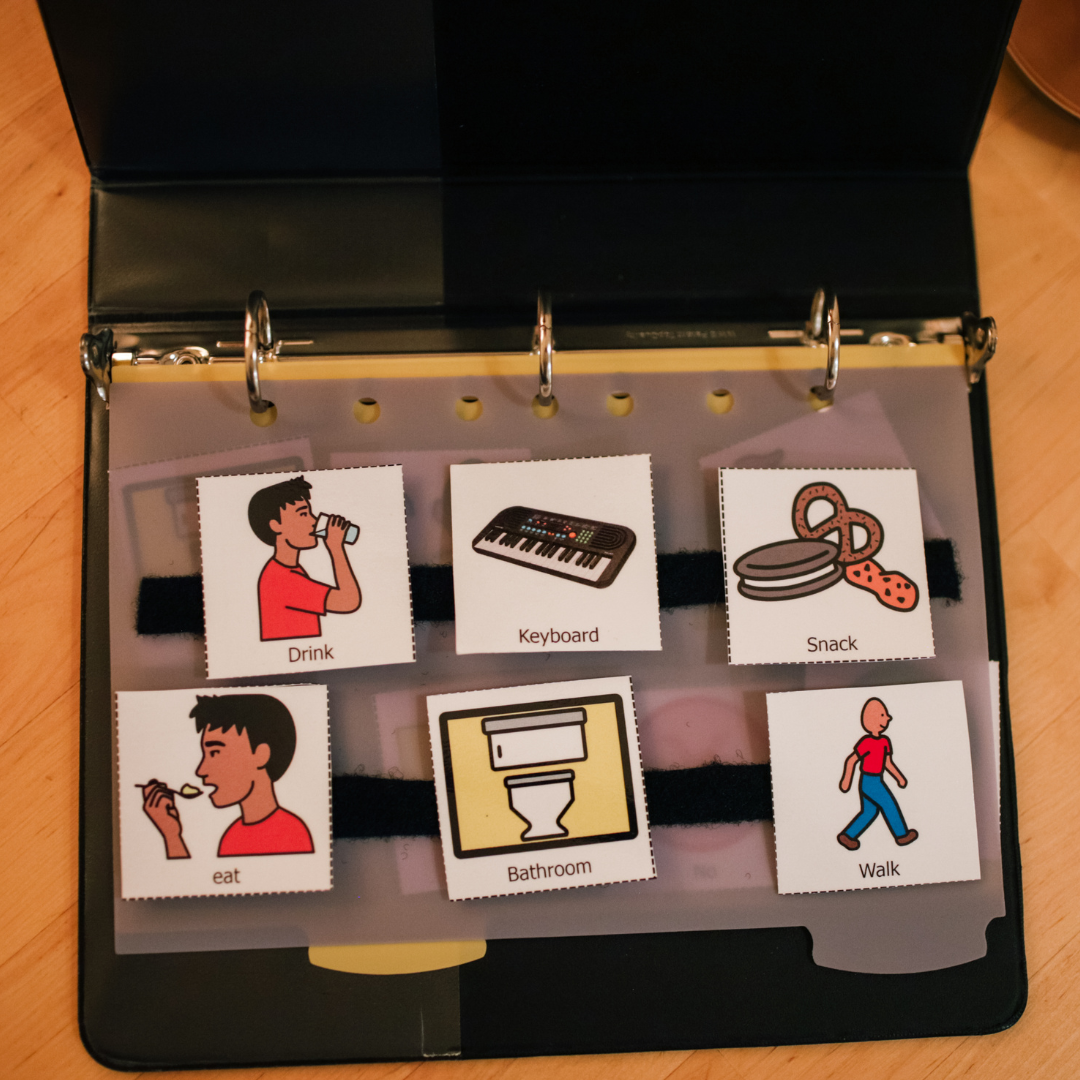
Visual supports are commonly useful across autism, ADHD, and anxiety because they make information available after spoken language disappears.
A verbal instruction such as:
“Finish your writing, put it in the folder, clean your desk, get your backpack, and line up.”
requires the child to listen, understand, retain, sequence, and execute several actions.
A written or picture-based sequence leaves the information in the environment:
Finish writing → Folder → Clean desk → Backpack → Line up
This can reduce demands on working memory and language processing while making the sequence more predictable.
Visual schedules are often associated with autism support, but the underlying principle applies much more broadly. A child with ADHD may use a checklist because the problem is remembering and sequencing. A child with anxiety may use a schedule because knowing what comes next reduces uncertainty.
Visual support is therefore not a treatment for a diagnosis. It is a method for changing the task demands.
Predictability Can Reduce Unnecessary Stress
Unexpected change is difficult for many children, but it can be particularly disruptive for children with autism or anxiety.
Predictability does not require making every day identical.
It means providing enough information that the child can understand what is happening and prepare for change.
A visual schedule might show that occupational therapy replaces recess today.
A parent might say:
“We are going to the store. We need three things, and then we are coming home.”
A teacher might warn:
“We have five minutes left, then we are putting the project away.”
For an anxious child, predictability can reduce uncertainty. For a child with ADHD, advance notice can support transition from one attentional set to another. For an autistic child, it can reduce the processing burden created by unexpected change.
However, predictability should not become a requirement that the world never changes. When flexibility itself is a treatment target, clinicians can introduce manageable changes gradually while preserving enough structure for the child to understand what is happening.
Behavioral Intervention: Match the Method to the Target
Behavioral intervention remains an established component of treatment for many children with autism and ADHD, but the phrase covers a broad range of methods.
Applied Behavior Analysis (ABA) uses principles of learning and reinforcement to teach skills and alter environmental contingencies. ABA-based approaches may address communication, adaptive skills, learning, safety, self-care, or behaviors that interfere with participation.
The evidence is more nuanced than describing ABA as universally effective for every autistic child.
A 2023 meta-analysis of comprehensive ABA-based interventions found moderate effects on intellectual functioning and adaptive behavior compared with usual care or minimal treatment, while language ability, autism symptom severity, and parent stress did not show superiority over comparison groups.
Earlier Cochrane work on early intensive behavioral intervention found possible gains in adaptive behavior, language, and cognitive measures but rated the overall evidence as low or very low quality because most included studies were small and nonrandomized.
More recent autism intervention research includes naturalistic developmental behavioral interventions (NDBIs), which combine behavioral learning principles with developmental strategies delivered in play and everyday interaction. Reviews report positive effects in areas such as social engagement, expressive language, play, and cognitive development, although the magnitude and certainty of effects differ across outcomes and studies.
The appropriate conclusion is not that one model is always superior.
Treatment should be selected according to the child's age, communication profile, adaptive skills, goals, learning style, family priorities, and response to intervention.
Not every autistic trait requires treatment. Intervention is most defensible when it addresses areas such as communication access, safety, independence, participation, distress, learning, or a barrier identified by the child or family rather than simply trying to make a child appear less autistic. ASHA's current autism guidance similarly emphasizes individualized communication goals and recognizes both person-centered and neurodiversity-informed approaches.
Parent Training Has a Strong Evidence Base—but the Goal Depends on the Condition
Parent training warrants a central role in many support plans.
The evidence is especially strong for behavioral parent training in ADHD.
Current CDC and American Academy of Pediatrics guidance recommends parent training in behavior management as the first-line treatment for children with ADHD under age 6. For older children, behavioral parent approaches may be combined with medication, classroom intervention, and other treatment components.
Behavioral parent training teaches parents to change the environment around behavior rather than repeatedly telling a child to “try harder.” Programs commonly address clear expectations, reinforcement, consistent responses, parent-child interaction, routines, and structured consequences.
Meta-analytic evidence supports effects not only on child behavior but also on parenting confidence, parent-child relationships, and parenting practices, with several benefits persisting beyond the end of treatment.
Parent training has also been studied in autism.
In the large 2015 randomized trial by Bearss and colleagues, 180 children ages 3–7 with autism and disruptive behavior were assigned to structured parent training or parent education. Parent training produced larger reductions in irritability and noncompliance, and blinded evaluators rated 68.5% of children in the parent-training group as showing a positive clinical response compared with 39.6% in parent education. The investigators also cautioned that some parent-rated improvements did not meet their prespecified threshold for minimal clinical importance.
That qualification is important.
The study supports parent training for disruptive behavior in autism. It does not demonstrate that parent training eliminates autism, nor should it be described that way.
Anxiety in Autistic Children May Not Look Like Conventional Worry
Anxiety can be easy to miss when a child does not describe internal feelings directly.
The American Academy of Pediatrics notes that anxiety in autistic children may appear through increased behavioral distress, repetitive behavior, perseverative thinking, or difficulty tolerating social, academic, and environmental demands. Some children may lack the language or insight required to explain what they are experiencing.
Anxiety may therefore appear as:
refusal to enter unfamiliar settings;
repeated reassurance seeking;
distress when plans change;
avoidance of certain people, places, or tasks;
physical complaints before school;
increased dependence on routines;
difficulty separating from caregivers;
sleep disruption;
irritability or shutdown around feared situations.
None of these behaviors proves an anxiety disorder.
Autistic routines, sensory preferences, restricted interests, communication difficulty, and anxiety can overlap. Assessment needs to determine whether fear, worry, avoidance, or physiological arousal is contributing to the behavior.
The 2024 community-based meta-analysis of autistic youth found anxiety symptoms in approximately 33% and diagnosed anxiety disorders in approximately 19%, while also documenting substantial variation depending on the assessment method.
Cognitive Behavioral Therapy Has the Strongest Psychological Evidence for Anxiety
For school-age autistic children who can participate in the treatment format, cognitive behavioral therapy (CBT) has one of the strongest evidence bases for co-occurring anxiety.
CBT for childhood anxiety generally teaches children to identify anxiety, examine anxious predictions, build coping strategies, and gradually approach feared situations rather than continually avoiding them.
For autistic children, treatment often requires adaptations.
Sessions may use more visual material, concrete language, explicit emotion teaching, additional caregiver involvement, repetition, structured practice, and modifications that account for social communication or self-regulation differences.
A meta-analysis of 19 randomized controlled trials involving 833 autistic young people found significant reductions in anxiety after CBT. Effects were largest on clinician ratings and smaller—but still significant—on parent and child ratings.
A large randomized clinical trial of 167 children ages 7–13 compared standard CBT, autism-adapted CBT, and treatment as usual. Both CBT programs produced substantially higher treatment-response rates than usual care, while the autism-adapted program showed additional advantages on several outcomes.
Adaptation should not mean removing the active ingredients of anxiety treatment.
For many anxiety disorders, graded exposure to feared situations remains an important component of CBT. The clinician helps the child approach manageable versions of the feared situation while reducing unnecessary avoidance and building coping skills.
At the same time, exposure should not be confused with forcing a child to tolerate pain, sensory distress, inaccessible communication demands, or environments that could reasonably be modified.
The clinical task is to distinguish a disability-related access need from anxiety-driven avoidance.
Co-Occurring ADHD Does Not Automatically Prevent CBT From Working
This question has become increasingly relevant because autism, ADHD, and anxiety often occur together.
A 2025 analysis of the same multisite CBT trial examined 167 autistic children with anxiety. Sixty-two percent also met diagnostic criteria for impairing ADHD within the study sample.
Children with ADHD had greater anxiety severity and greater anxiety-related school impairment before treatment.
However, ADHD did not predict a poorer anxiety response to CBT.
Both standard and autism-adapted CBT remained effective options for treating anxiety in children who also had ADHD.
This is clinically useful because the presence of ADHD should not automatically be treated as a reason to postpone anxiety treatment.
It may, however, require changes in delivery: shorter tasks, more active practice, visual structure, repetition, breaks, external organization, and caregiver support may help a child participate more successfully.
.png)



.png)