Get the free speech therapy data sheets
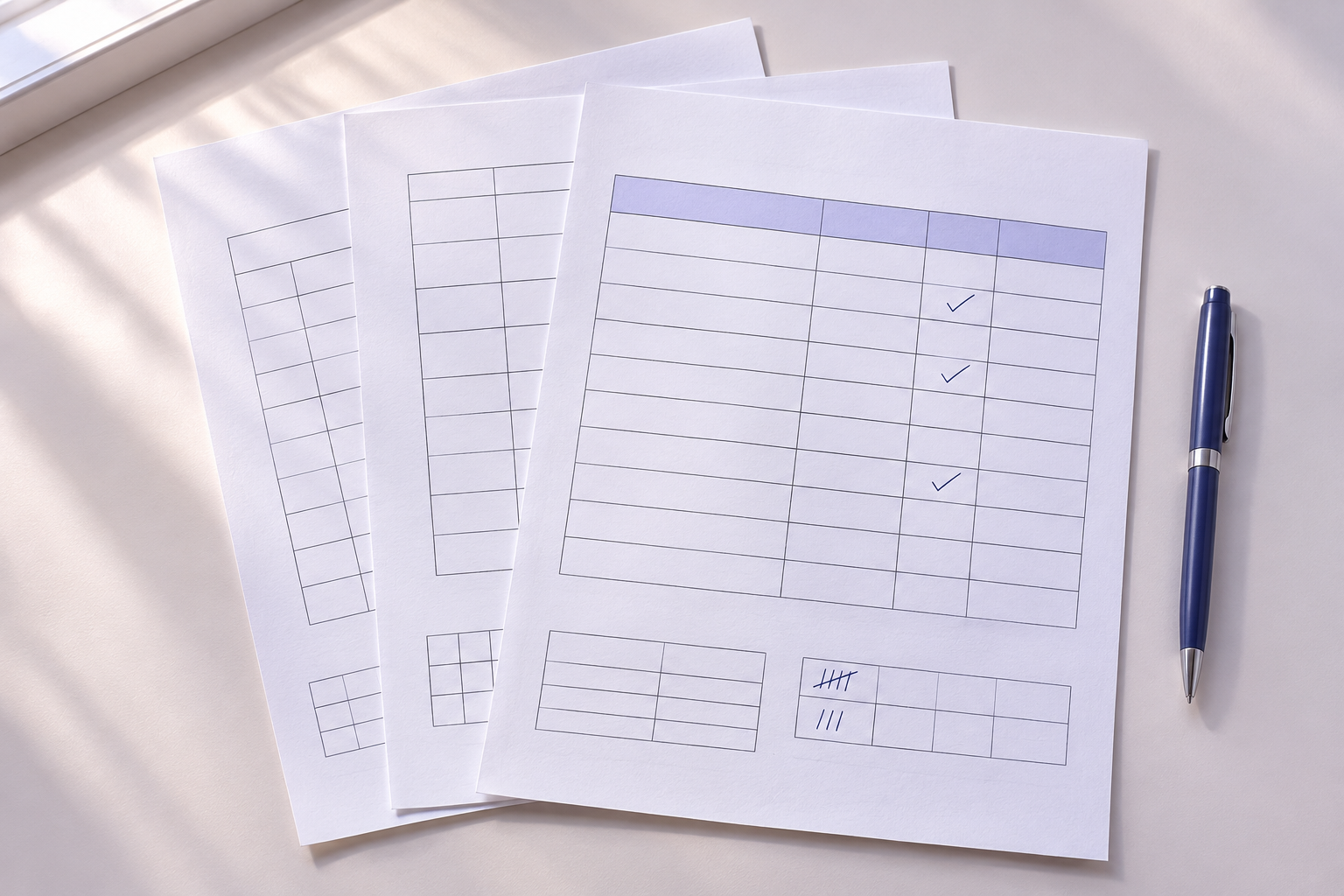
Choose a printable PDF you can use during a session. The individual sheet has space for different goal measures, the group sheet keeps student results separate, and the articulation sheet lets you score each production. The filled-in example shows what to write before, during, and after a session.
Get the free Speech Therapy Data Sheets pack that includes all four pages in one PDF.
These are original iSpeax templates, not official forms. Use your school, agency, or clinic’s required documentation process. If you’re deciding which measure to use rather than looking for a form, read the guide to speech therapy data collection.
What to write on an SLP data collection sheet
Imagine you open a sheet a week after the session and see “80% accuracy.” Was that four of five trials or 16 of 20? Were the responses independent, or did the student use a choice of two answers? The score is much easier to use when those details sit right beside it.
Start with the date, the student identifier your setting permits, and the goal or goal code. Add the task and write what counts as a response. For a student working on inferencing, “answer an inference question about a short paragraph and point to or explain a supporting clue” is specific enough to tally. “Reading comprehension” identifies the area, but it doesn’t tell the next person how the responses were scored.
Next, add the measurement unit and any relevant conditions. If the goal is written as a percent, record the count and denominator as well. If the goal is written as a frequency within a set observation period, record the number and the time window. Note the supports that matter to interpretation: a picture cue, a verbal prompt, a direct model, or an accommodation that was already part of the task. A student’s usual access supports should not automatically be counted as added prompts. For example, if a goal permits a student to answer with a speech-generating device, using that device doesn’t make the answer prompted. ASHA’s AAC guidance describes how communication modes and access methods can differ by person and context.
Choose the measurement unit before the session
An observation line is useful when a number doesn’t tell the whole story. “Answered correctly when the picture stayed visible; did not yet attempt the same task without the picture” gives you something to check next time. It’s more useful than “did well,” and it doesn’t claim that the student needed the picture in every setting.
How to use the Individual Session Data Sheet
Before the session, fill in the goal and task, then mark the rows you actually plan to use. A single page can hold more than one goal, but the results should not run together. On the Individual and Group Session Data Sheets, use the count fields for trial-based goals and the “Cue level / other measure or note” field for the cue level or a measure such as frequency, duration, or a rubric score. For example, a student might answer inference questions and retell a story in the same lesson. Record the inference answers as correct opportunities and capture the retell as story elements included. Keep a separate result for each.
During the activity, write the shortest mark you can still interpret later. If you’re tallying trial by trial, you can use the same legend as the Articulation Trial Data Sheet: I for an independent correct response, P for a correct response after a cue, and X for an incorrect response. Define the cue in the margin or on the sheet. Leave boxes for unattempted opportunities blank. A planned but unadministered item is different from a presented item where the student didn’t respond. Count only attempted opportunities that you scored. Leave unattempted or blank trials out of the denominator. Agree beforehand how to handle an administered opportunity with no response or a trial interrupted before it can be scored. If two goals use different cue levels, record the cues with each goal rather than assigning one cue level to the whole session.
Filled-in example: Initial /k/ in words
In this fictional example, the student named pictures with initial /k/ in the target words. The clinician scored 10 opportunities. If the student did not produce initial /k/ correctly on the first attempt, the clinician gave one verbal cue.
The independent score is 7/10 (70%). With independent and cued correct responses combined, the score is 9/10 (90%). These scores answer different questions. A note could say: “During picture naming, the student produced initial /k/ independently in 7/10 scored trials. Two additional productions were correct after one verbal cue; one trial remained incorrect.”
A data sheet records what you observed. Your session note may also need the service details, intervention, clinician actions, response, and other fields required by your setting. ASHA distinguishes school treatment notes from progress reports and describes setting-specific health care documentation.