Early Language Development

How Children Begin to Communicate

Definition

What Is Early Language Development?

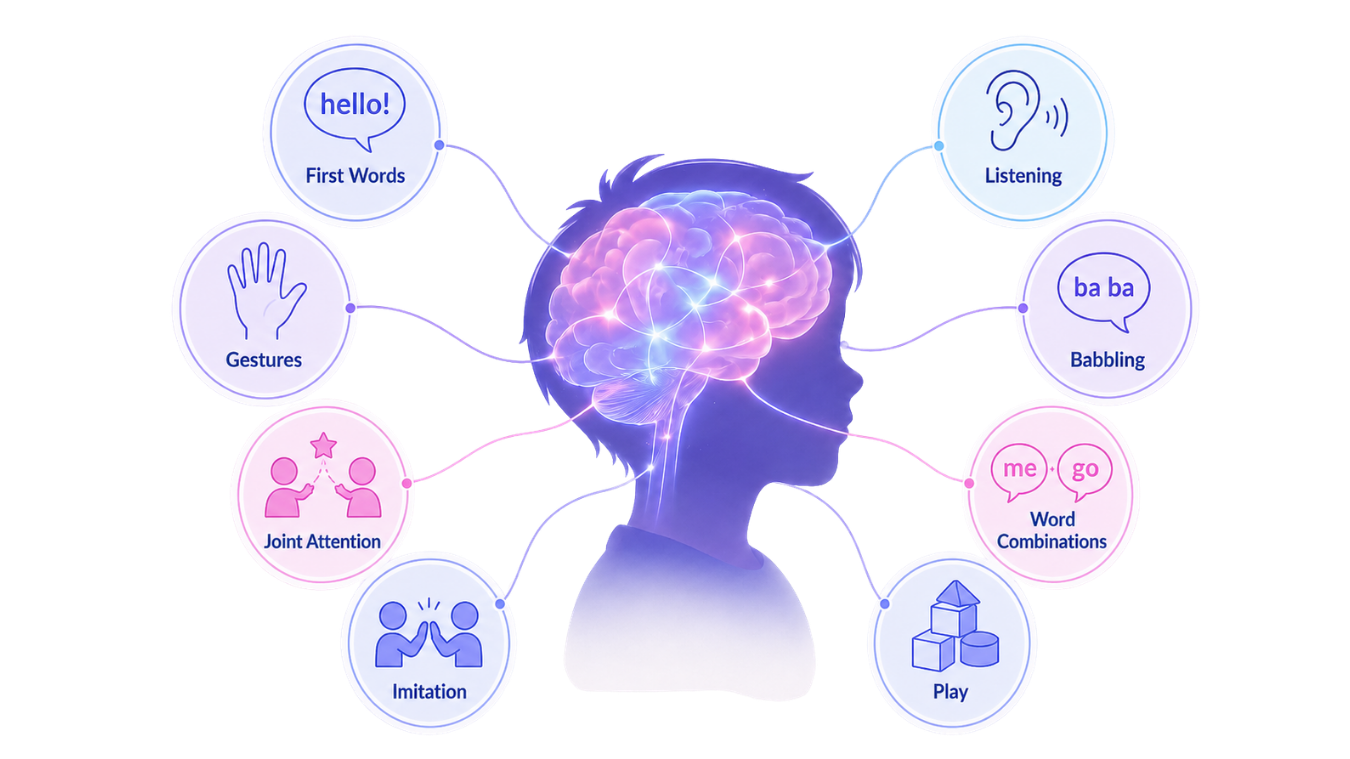
Early language development is the process children go through as they learn to understand and use communication. It includes the skills that appear before spoken words, such as listening, looking, smiling, reaching, pointing, babbling, taking turns with sounds, copying actions, and sharing attention with another person.

A child starts building early language skills when they turn toward a familiar voice, smile during a social routine, reach to be picked up, point to show something interesting, imitate a sound, or respond to a familiar word such as “bye-bye,” “milk,” or “up.”

As the child grows, early language development expands into first words, functional vocabulary, two-word combinations, short phrases, simple questions, pretend play, early stories, and conversation. These skills support later speech development, receptive language, expressive language, social communication, school readiness, and early literacy.

A child shows early language skills when they:

respond to familiar sounds, voices, or routines
look toward people during interaction
use gestures such as reaching, waving, pointing, or showing
babble or make repeated sounds
imitate sounds, actions, or words
understand familiar words
use first words to request, label, protest, or comment
combine words such as “more juice” or “go outside”
participate in book reading, songs, play, and daily routines
begin using language to share needs, feelings, and ideas

The first few years of life are an especially active period for speech and language development. During this time, children learn through repeated and familiar interactions with caregivers, siblings, and peers.

Speech vs. Language Development

What Is the Difference Between Speech Development and Language Development?

Speech development and language development are not the same. Speech development refers to how children learn to produce sounds and spoken words. It includes speech sound production, articulation, and motor coordination needed for speech. Language development refers to how children understand and use language. It includes gestures, words, meanings, sentences, questions, directions, stories, play, and social interaction.

When a child knows what they want to say but has difficulty producing sounds - that is more related to speech. When a child pronounces words clearly but has difficulty understanding directions, learning words, combining words, or using language to communicate - that is more related to language.

The differences might seem subtle, but it is important to draw a distinction because searching “speech delay” when the main concern is the communication itself would draw inaccurate results. Sometimes the issue might be in speech sound production. Sometimes it is language understanding, word use, gesture, social communication, or overall development.

Area
Speech Development
Language Development
Main focus
Producing sounds and spoken words
Understanding and using language
Includes
Articulation, speech sounds, intelligibility, motor speech coordination
Gestures, vocabulary, comprehension, word combinations, sentences, answering questions, conversation
Example
A child tries to say “truck” but it sounds "tuk"
A child does not understand “get your shoes” or does not use words
Common concern
“I cannot understand what my child is saying.”
“My child is not using words,” “My child does not follow directions,” or “My child does not combine words.”

A speech-language evaluation can help determine whether a child’s needs are mostly related to speech, language, social communication, hearing, development, or a combination of areas.

Early Language Skills

What Skills Help Early Language Development?

Early language development is built from many connected skills. Some children begin using words before families realize how much foundation has already developed underneath those words.

Listening and Responding

Children first learn language by noticing sounds, voices, patterns, and familiar routines. A baby may calm to a caregiver’s voice, turn toward sound, or smile when a familiar song begins. Over time, children begin linking words to people, objects, actions, and daily routines. Early listening skills support later understanding of names, directions, questions, stories, and conversation.

Examples include:

turning toward a voice or sound
responding to a familiar name
recognizing routines such as bath time or bedtime
looking at a named object
following simple familiar directions
listening during songs or books

Gestures and Joint Attention

Gestures are one of the strongest early signs that a child is learning to communicate intentionally. Before children use many words, they may reach, wave, point, show, give, push away, nod, or shake their head.

Joint attention means the child and another person share focus on the same object, person, or event. For example, a child may point to an airplane, look at the adult, and then look back at the airplane. That is not just requesting. It is sharing attention, which is an important foundation for language and social communication.

Examples include:

pointing to request
pointing to show
giving an object to an adult
looking between a person and a toy
waving hello or goodbye
lifting arms to be picked up
showing a caregiver something interesting

Babbling and Vocal Play

Babbling helps children practice the rhythm and sound patterns of communication. Babies may coo, squeal, laugh, blow raspberries, repeat syllables, or take turns making sounds with a caregiver.

Babbling does not have to sound like real words. It is part of the pathway toward speech development, expressive language, and social communication.

Examples include:

cooing
squealing
laughing
repeating “bababa” or “mamama”
mimicking sounds
using sounds to get attention

First Words and Word Meaning

First words usually come from familiar routines and experiences. Children often say names of people, favorite foods, toys, animals, actions, or social words because those words are useful in daily life. Common early word types include:

Word Type
Examples
People
mama, dada, nana
Social words
hi, bye, more, no
Objects
ball, cup, shoe, book
Actions
go, eat, open, up
Animals
dog, cat, duck
Routines
bath, milk, night-night

Play and Imitation

Play gives children reasons to communicate. During play, children copy actions, imitate sounds, take turns, pretend, request objects, label what they see, and share attention with others.

Pretend play becomes especially important as toddlers and preschoolers begin using objects and words symbolically. Feeding a doll, making a car drive, pretending to cook, or acting out animal sounds all support early language development.

Word Combinations and Early Sentences

As children learn more words, they begin combining them into phrases. Early word combinations may include requests, comments, actions, locations, protests, and descriptions. Examples:

“more milk”
“mommy up”
“go car”
“big truck”
“dog run”
“open door”

Early word combinations help children transition from single words into phrases, sentences, and early conversation.

Communication Milestones

Early Language Development Chart

Communication milestones are general guides, not diagnostic tools. Children develop at different rates, and one missed milestone does not automatically mean a child has a speech delay or language disorder. Milestones can help families, pediatricians, teachers, and speech-language pathologists notice when a child may need support.

Age Range
Early Communication Skills Children May Show
Birth–6 months
Communicates by crying, sounds, facial expressions, and body movement; responds to familiar voices; begins cooing and vocal play; watches faces during interaction
7–12 months
Turns toward sounds, listens when spoken to, responds to familiar words, babbles in strings, uses gestures, plays social games, and may use one or two words by the first birthday
12–18 months
Follows simple familiar directions, points or gestures to communicate, recognizes common objects or people, learns new words, and begins using words functionally
18–24 months
Vocabulary expands, two-word combinations may emerge, children use words to request or label, and many children can follow simple one-step directions and related two-step commands
2–3 years
Uses words for many familiar things, combines two to three words, asks simple questions, names objects, follows new directions, and becomes more understandable to familiar listeners
4–5 years
Answers simple WH questions, uses longer sentences, talks about recent activities, participates in symbolic play, and begins having longer conversations
4–5 years
Stays on topic more often, answers simple story questions, communicates with more people, uses more adult-like grammar, and tells simple stories
6 years +
Persistent concerns beyond kindergarten are no longer only “late talking.” Ongoing difficulty with vocabulary, understanding, sentence use, storytelling, social communication, or early literacy may warrant fuller evaluation

For infants and toddlers, early language development is closely tied to interaction, routines, play, hearing, gestures, and shared attention. For preschoolers and children entering school, language demands expand into stories, questions, peer play, classroom directions, early literacy, and participation in group routines.

Signs of Speech or Language Delay

Signs of Speech Delay or Language Delay

Speech delay and language delay can look different depending on a child’s age, hearing status, overall development, language environment, temperament, and communication opportunities.

A child with early communication difficulty may have trouble responding to sounds, using gestures, learning first words, combining words, following directions, participating in play, or communicating needs clearly. Some children mainly have difficulty producing speech sounds. Others have difficulty understanding or using language. Some children have both.

A single concern does not diagnose a delay or disorder. However, persistent concerns, regression, weak comprehension, limited gestures, or difficulty participating in everyday routines are reasons to seek guidance.

Signs in Infants

An infant may show early communication concerns if they:

do not respond consistently to sounds or familiar voices
have limited cooing, vocal play, or babbling
rarely smile or respond during social interaction
do not seem to notice people speaking
have limited back-and-forth sound play
do not turn toward sound
show limited interest in faces, voices, or social games
lose previously used sounds or social responses

Signs in Young Toddlers

A young toddler may show speech or language concerns if they:

use very few gestures
do not point, show, wave, or reach to communicate
use just very few words
do not seem to understand familiar words
have difficulty following simple familiar directions
rely mostly on crying, pulling, or leading adults by the hand
do not imitate sounds, words, or actions
show limited interest in shared play or books

Signs in Older Toddlers

An older toddler may show language delay if they:

are not combining words
have a very small vocabulary compared with peers
use mostly single words when other children are using short phrases
have difficulty naming familiar objects or people
have difficulty following one-step directions
do not use words for different purposes, such as requesting, commenting, protesting, or greeting
have limited pretend play
are difficult for familiar adults to understand
become frustrated when others do not understand them

Signs in Preschool Children

A preschool child may show ongoing language concerns if they:

use short or immature sentences
have difficulty answering simple questions
use limited vocabulary
struggle to tell what happened
do not stay on topic in simple conversations
have difficulty understanding stories
are hard for unfamiliar listeners to understand
show frustration, withdrawal, or behavior during communication-heavy tasks
Late Talker, Late Bloomer, or Language Disorder?

What Is the Difference Between a Late Talker, Late Bloomer, and Language Disorder?

Families often mistake “late talker vs autism,” “late talker vs late bloomer,” or “late talker vs language delay”. The terms are not the same although there might be some overlapping communication issues.

A late talker is usually a toddler who begins using spoken language later than expected, often with otherwise typical development in other areas. Clinicians may describe this as late language emergence when language onset is delayed in a young child without another diagnosed developmental delay.

A late bloomer is a child who catches up later. A family can determine if the child was actually a late bloomer after the child has caught up in all areas of development.

A language delay means a child’s communication skills are developing more slowly than expected. This may involve understanding, gestures, vocabulary, using words or word combinations, sentences, play, or social communication.

A language disorder means a child has persistent difficulty understanding or using language that affects communication, learning, social participation, or daily functioning.

Some late talkers "catch up" with support and monitoring. Others continue to show language, literacy, social communication, or academic needs as language demands increase. This is why “wait and see” should not replace active monitoring, hearing checks, screening, or speech-language evaluation when concerns persist.

Examples

Examples of Early Language Development in Everyday Life

Early communication skills develop during everyday routines such as feeding, dressing, play, shared book reading, sing-along, outdoor time, bath time or family interactions.

At Home

A child uses early language at home when they:

look toward a parent’s voice
reach to be picked up
point to a snack
wave bye-bye
say “more” during mealtime
bring shoes when it is time to go outside
follow a familiar directions such as “get your cup”
say “mama up” or “open door”

During Play

A child uses early language during play when they:

imitate animal sounds or car sounds
take turns rolling a ball
point to a toy to show an adult
play with cars and say “beep beep”
pretend to feed a doll
say “go” before pushing a train
copy an adult’s action or sound

During Book Reading and Songs

A child uses early language during book-reading and sing-along routines when they:

look at pictures
point to named objects
turn pages
imitate sounds in a song
fill in a familiar word
sign along with a song
ask for the book again

In Daily Routines

A child uses early language in routines when they:

understand “time for bath”
follow “put it in”
say “all done”
protest with a word or gesture
ask for help
choose between two items
use words for familiar people or objects
anticipate what comes next in a routine
Early Language Difficulties in Learning and Behavior

How Early Language Delays Can Affect Learning and Behavior

Early language difficulties can affect much more than talking. When a child has difficulty understanding or using communication, the impact can show up across daily routines. They may have trouble following directions, expressing needs, joining play, participating in book reading, communicating with caregivers, or managing transitions.

Some children become quiet or withdrawn. Others may cry, grab, hit, run away, refuse, or become frustrated when they cannot communicate clearly. In some cases, behavior may be related to difficulty understanding language, expressing needs, or participating in a routine.

Early language difficulties can affect:

requesting help
play skills
social interaction
peer interaction
following directions
preschool participation
attention
frustration tolerance
early literacy readiness
vocabulary growth
Speech Therapy

How Speech Therapy Supports Early Language Development

Speech-language pathologists support early communication, speech, and language development. In early intervention, therapy is individualized based on the child’s age, communication profile, family priorities, hearing and developmental history, language environment, play skills, understanding, expression, and daily routines.

Speech therapy in early intervention is not only about getting a child to say more words. It may also focus on how the child communicates, what they understand, how they use gestures, how they participate in routines, how they play, how they imitate, and how caregivers can support communication throughout the day.

Speech therapy for early language development may focus on:

shared attention
responding to name or familiar voices
using gestures
pointing to and identifying objects
imitation
vocal play and babbling
saying first words
saying first words
growing vocabulary
requesting and protesting
following simple directions
combining words
pretend play
caregiver coaching

For infants and toddlers, therapy may involve parent coaching, play-based interaction, routines, modeling, imitation, wait time, gestures, songs, and natural opportunities for communication. For preschoolers, therapy may support vocabulary, sentence expansion, WH questions, pretend play, early narratives, social communication, following directions, and participation in classroom or preschool routines. Therapy that helps children communicate during the real-time routines, interactions, and activities is the most effective.

Early Intervention Language Assessment

What Happens During an Early Language Assessment?

An early language assessment may include formal and informal tools. Screening can help identify whether a comprehensive assessment is needed.

A comprehensive early intervention language assessment may include:

parent or caregiver questionnaries
developmental and medical history
hearing screening or audiology referral
family history of speech, language, or learning concerns
language exposure and languages used at home
observation during play, routines, books, or interaction
response to name, sound, words, and directions
gesture use, pointing, showing, and joint attention
babbling, vocal play, sound and word use
understanding of familiar routines and directions
play skills and pretend play
parent-child interaction
standardized testing when appropriate
Early Intervention Language Goals

Early Language Goals for Speech Therapy and Early Intervention

Early intervention communication goals should be specific, measurable, functional, developmentally appropriate, and connected to the child’s daily routines. The goal is not only to increase word count. Strong goals help children communicate intentionally, participate in routines, understand familiar language, use gestures or words, and interact with people in meaningful ways.

For infants and toddlers, goals may include shared attention, gestures, imitation, vocal play, first words, requesting, commenting, following simple directions, and participation in routines. For preschoolers, goals may include vocabulary, word combinations, sentence expansion, pretend play, WH questions, early stories, and classroom participation.

A SMART early intervention communication goal should describe:

time reference
specific skill being targeted
context or activity
level of support
measurable outcome
how progress is measured
Early Language Area
SMART Goal Example
Joint Attention Goal
By the next IFSP period, during play or book reading, the child will shift attention between an object and adult by looking, pointing, showing, or vocalizing in 4 out of 5 opportunities, given fading cues.
Gesture Goal
By the next IFSP period, during daily routines, the child will use a gesture such as pointing, touching, waving, or signing (e.g., "more"), to request, greet or identify, in 4 out of 5 opportunities, given moderate visual cues.
Functional Communication Goal
By the next IFSP period, during meals, play, or routines, the child will communicate a request, protest, or comment using a word, sign, gesture, or vocalization in 4 out of 5 opportunities.
First Words Goal
By the next IFSP period, during preferred routines, the child will use at least 10 functional words, signs, or word approximations to request, label, greet, or comment across three different routines.
Combining Words Goal
By the next IFSP period, during play and daily routines, the child will make two-word utterances, such as “more bubbles,” “mommy up,” or “go car,” in 4 out of 5 opportunities, given models and prompts.
Receptive Language Goal
By the next IFSP period, given a familiar routine, the child will follow one-step directions such as “give me,” “put in,” or “get shoes” in 4 out of 5 opportunities, given gestures or visual support as needed.
Imitation Goal
By the next IFSP period, during play, songs, or routines, the child will imitate an action, sound, word, or gesture in 4 out of 5 opportunities, given adult modeling.
Pretend Play Goal
By the next review period, during play routines, the child will engage in pretend play, and imitate actions such as feeding a doll or making a toy animal sleep, in 4 out of 5 opportunities, given modeling as needed
Sentence Expansion Goal
By the next IFSP period, during conversation and routines, the child will produce three- to four-word phrases to comment, request, or describe in 4 out of 5 opportunities, given minimal verbal prompts.
Early Intervention Language Activities

Early Language Activities for Children

Early intervention language activities should be taking place around routines, play, book reading, sing-alongs, and everyday interactions. Early intervention language activities need to help children communicate with intent, around a family member, during activities that happen throughout the day.

Early Intervention Language Activities for Babies

Try activities such as:

talking during diaper changes, feeding, and dressing
copying the baby’s sounds
pausing for the baby to vocalize back
singing simple songs
playing peekaboo
naming familiar people and objects
showing different facial expressions and gestures
reading simple busy books

For example: If a baby coos, pause, smile, and coo back. This teaches early turn-taking and helps the baby learn that sounds can create a social response.

Early Intervention Language Activities for Young Toddlers

Try activities such as:

offering choices, such as “apple or banana?”
modeling simple words during routines
pointing to and naming pictures in books
using gestures with words
singing songs with repeated phrases
playing “ready, set, go” and waiting for the child to fill in the phrase
naming actions during play
waiting before helping so the child has a chance to ask for help
expanding a child’s word into a short phrase

For example: During snack, hold up two choices and wait. If the child points to crackers, say, “Cracker. You want cracker.” If the child says “cracker,” expand with “more cracker” or “eat cracker.”

Early Intervention Language Activities for Older Toddlers

Try activities such as:

modeling two-word phrases
modeling everyday routines during pretend play
expanding single words into short phrases
reading books and asking simple questions
playing with animals, cars, food, dolls, or blocks
asking to follow simple directions during routines
using action words such as "go", "open", "eat", "jump", "wash", "sleep"

For example: If the child says “car,” model phrases such as “blue car,” “car go,” “push car,” or “more car.” The goal is to build language naturally around what the child is already interested in.

Early Language Activities for Preschoolers

Try activities such as:

shared book reading with open-ended questions
pretend play with simple scripts
retelling what happened first, next, and last
describing pictures
sorting objects into categories
using sentence starters
practicing WH questions
naming feelings during stories or routines
talking about the day

For example: After reading a short book, ask, “Who was in the story?” “What happened?” and “What did they do next?” If the child gives a short answer, model a complete sentence.

Data Collection

Data Collection for Communication and Language Goals

SLPs often need to document not only whether a student performed a skill, but how much support was needed, how consistently the skill occurred, and whether the skill generalized across people, materials, or settings.

Accuracy and trials
Prompt level and cueing type
Level of independence
Frequency, duration, and rubric scores
Spontaneous use and generalization
See Data Collection Tools
Documentation

Documentation Examples for SLPs

Accurate documentation helps SLPs summarize what was targeted, how the student performed, what supports were needed, and how therapy connects to functional communication.

SOAP notes and session notes
Caregiver updates
IEP goal documentation
Evaluation summaries
Progress reports and present levels
Workflow

From Goal Writing to Progress Reports

Receptive language therapy is not one isolated session, it requires strcutured and individualized approach. iSpeax is designed to support  complete workflow from goal setting to intervention, data, collection, documentation management, finance, scheduling and more.

1
Choose communication skill
2
Write measurable goals
3
Plan therapy activities
4
Collect session data
5
Document progress
6
Generate reports
Early Language FAQ

Frequently Asked Questions

What is early language development?

Early language development is how children learn to understand and use language. It begins before the child acquires first words and includes listening, gestures, babbling, joint attention, imitation, and play, leading up to first words, word combinations, sentences, and early conversation.

What is the difference between speech development and language development?

Speech development refers to how children learn to produce sounds and spoken words. Language development refers to how children understand and use language, including gestures, words, or sentences, for different functions such as requesting, protesting, or commenting.

What is a language delay?

A language delay means a child’s understanding or use of communication is developing more slowly than expected. It may involve later development in the use of gestures, vocabulary, comprehension, word combinations, sentences, play, or social communication.

What is a late talker?

A late talker is usually a toddler who begins using spoken words later than expected, often without another diagnosed developmental delay. Some late talkers catch up, while others continue to need language or learning support.

What is the difference between a late talker and a late bloomer?

A late talker is a child who is talking later than expected. A late bloomer is a child who later catches up to age expectations in all areas of the development. A family can determine if the child was actually a late bloomer after the child has caught up in all areas of development.

What is the difference between a late talker and a language delay?

A late talker usually refers to a toddler with delayed spoken language onset. Language delay is broader and may involve understanding, vocabulary acquisition, combining words, making sentences, or overall difficulty with expressing needs or understanding what is being said.

Does late talking mean autism?

No. Late talking alone does not mean autism. Autism involves broader patterns of social communication and behavior. However, delayed language can be one reason to look more closely at a child’s development, especially when there are concerns with shared attention, play, social interaction, or repetitive behaviors.

How do SLPs assess early language?

SLPs assess early language as part of an early intervention multi-disciplinary evaluation using multiple sources of information, such as parent input, developmental history, hearing screening, observation, speech sound assessment, language assessment, play observation, gesture use, receptive language assessment, expressive language assessment, and overall functional communication observation.

When should I worry about speech or language delay?

Concern is appropriate when a child is missing milestones, has lost skills, uses very few gestures or words, is not combining words, has difficulty understanding familiar language, becomes frustrated because they cannot communicate, or has persistent difficulty participating at home or preschool.

Can early language improve with therapy?

Yes. Early language can improve with support, especially when therapy is individualized and structured around daily routines. Speech-language therapy may include caregiver coaching, play-based intervention, shared book reading, targeted language modeling, use of gestures, signs, pictures, and direct support for understanding and using language.

Support Early Language Development with iSpeax

iSpeax helps speech-language pathologists, early intervention providers, educators, and therapy teams organize early language support, track session data, and manage documentation in one connected workflow.

From gestures, joint attention, imitation, and play to first words, word combinations, functional communication, and caregiver strategies, iSpeax helps providers connect early intervention planning to measurable progress and streamlined documentation.

Whether you are supporting toddlers, preschoolers, late talkers, or children with early communication delays, iSpeax helps turn therapy data into organized notes, progress updates, caregiver-friendly summaries, and compliant reports.